From APQP to Preventive Maintenance: How Automotive Connector Molds Support Stable Mass Production
In the previous article, we explored the differences between automotive connector molds and general molds in terms of mold life, dimensional accuracy, and material wear. This article further explores how automotive connector molds support long-term production stability through development validation, preventive maintenance, and vertical integration.
Development and Validation: Quality Management from APQP to Mass Production Launch
One of the major differences between automotive connector molds and general molds is that automotive connector molds must be integrated into a complete automotive quality management process. General mold development may place greater emphasis on whether a mold can produce parts according to specifications and meet delivery requirements. For automotive connector molds, it is essential not only to demonstrate that a part can be manufactured, but also to validate consistent production over the long term.
As a result, automotive mold development does not end when the mold is completed. It must be coordinated with product design, process planning, risk analysis, trial molding or trial stamping, mass production launch, and customer approval.
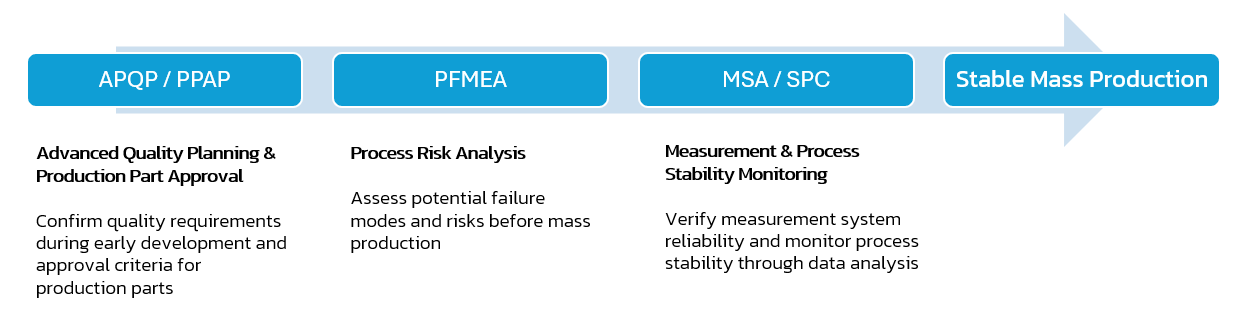
Before a mold is introduced into mass production, its development and validation typically involve several quality planning, approval, and process control activities, including:
- APQP (Advanced Product Quality Planning) and PPAP (Production Part Approval Process): Support early-stage quality planning and production part approval requirements.
- PFMEA (Process Failure Mode and Effects Analysis): Evaluate potential failure modes and process risks before mass production.
- MSA (Measurement System Analysis) and SPC (Statistical Process Control): Verify measurement system reliability and monitor process stability through data.
Although these processes may seem complex, they are essential for reducing mass production risks in the automotive supply chain. Whether it is poor contact caused by burrs on metal terminals or abnormal insertion force caused by warpage in plastic parts, insufficient validation during the development stage may amplify into quality issues during downstream assembly or field application.
For this reason, automotive connector mold development places greater emphasis on cross-functional collaboration and data-based validation, from DFM analysis and trial mold validation to process capability confirmation and documentation management.
This is where vertical integration becomes valuable in automotive connector manufacturing. When mold development is no longer treated as an isolated process, but instead works together with product design, stamping, injection molding, assembly, and validation, manufacturers can trace issues more completely and continue making improvements during both development and mass production.
At HULANE, extensive experience in mold development, stamping, injection molding, assembly, and validation enables a more integrated manufacturing approach. Rather than serving merely as tooling developed from engineering drawings, molds become part of a coordinated manufacturing process that supports stable mass production and consistent quality in automotive connectors.
From Reactive Repair to Preventive Maintenance: A Core Difference in Automotive Mold Management
Automotive connector mold management focuses not only on reliable production, but also on maintaining consistent dimensions, appearance, and functional performance throughout long-term mass production.
In the automotive supply chain, unexpected mold downtime or quality fluctuations may affect not only individual components, but also downstream assembly, delivery schedules, and customer production line stability.
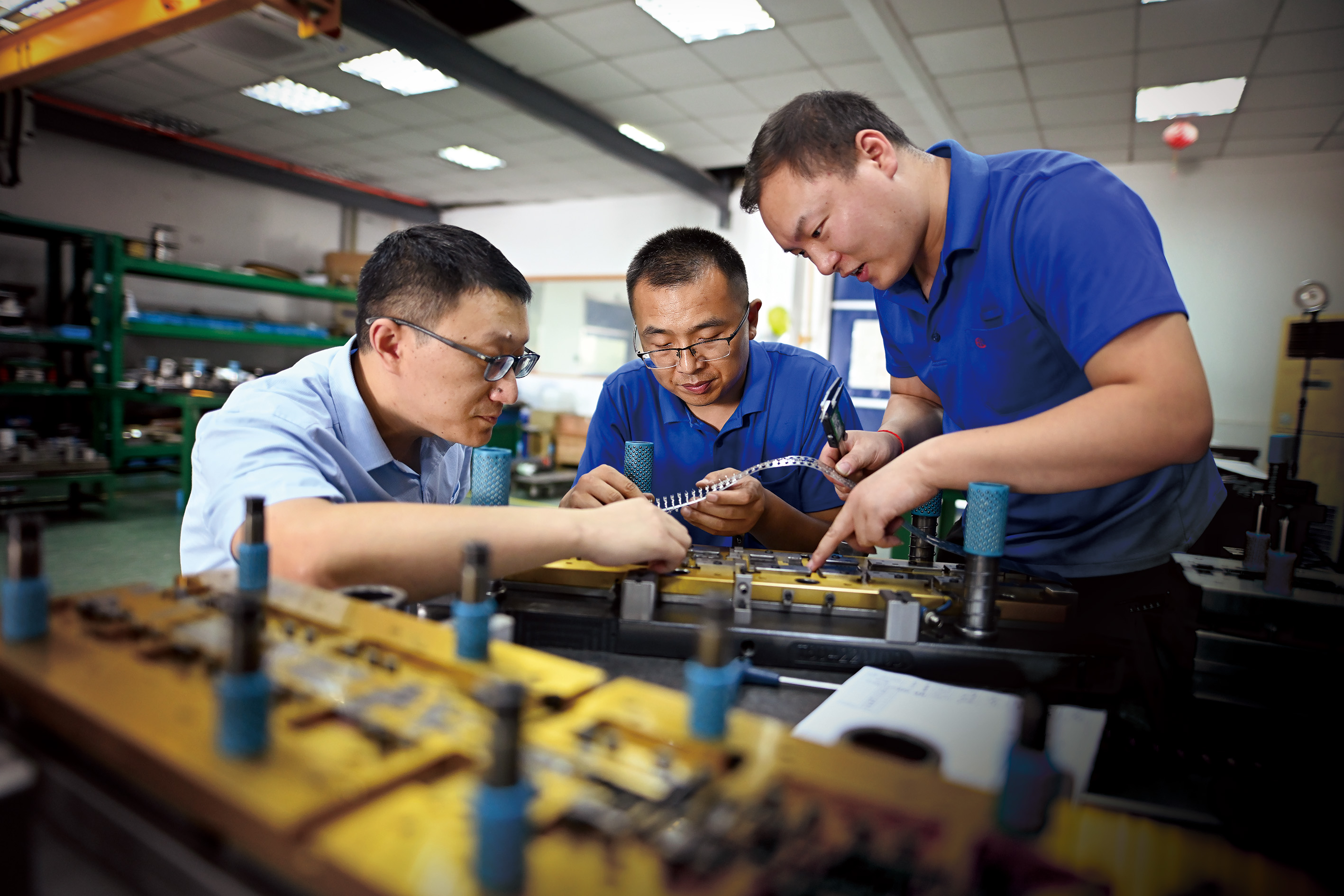
Therefore, automotive mold management places strong emphasis on preventive maintenance and periodic inspection. Through scheduled disassembly, cleaning, measurement, replacement of critical components, and tracking of abnormalities, manufacturers can identify and address potential issues such as excessive mold wear, dimensional drift, burr formation, deformation, and molding instability before they affect production.
Although metal terminal stamping dies and plastic injection molds involve different manufacturing processes, both require clearly defined maintenance schedules and closed-loop issue management.
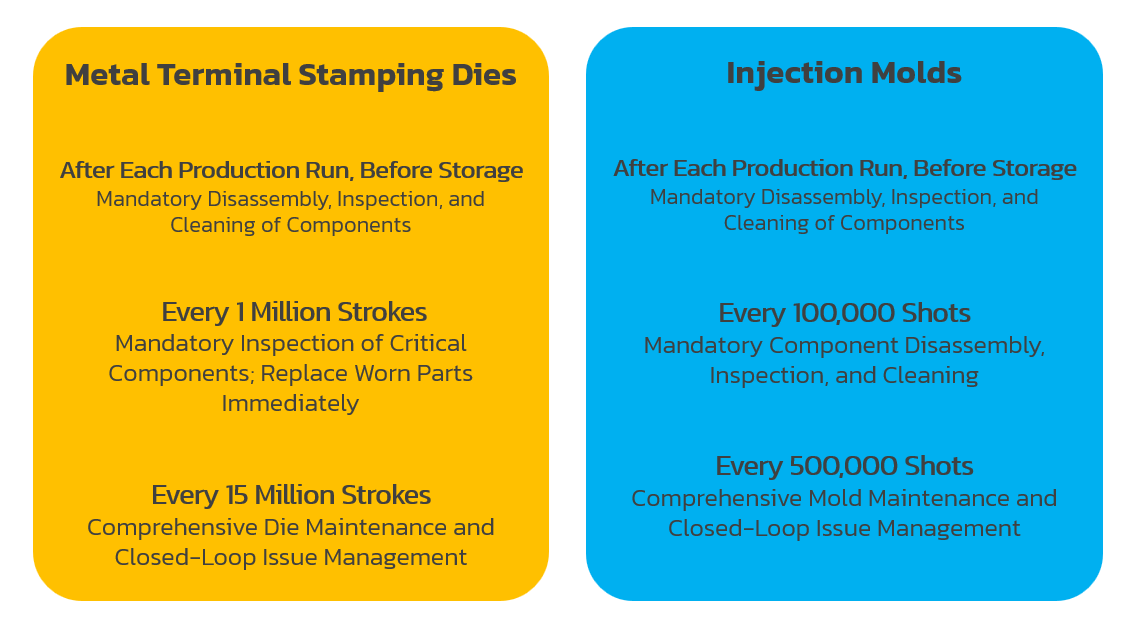
The core of this management approach is not to wait until problems occur, but to continuously monitor, maintain, and improve the mold throughout its lifecycle, ensuring consistent quality during long-term mass production. For HULANE, mold management is not merely a maintenance task, but part of mass production stability management. Through mold maintenance records, scheduled maintenance, replacement of critical components, and feedback on detected abnormalities, HULANE can continuously monitor mold conditions during long-term production, reducing the risk of quality fluctuations and unexpected downtime.
Conclusion: Mold Capability as the Manufacturing Foundation for Automotive Connector Reliability
The value of automotive connector molds lies not only in producing components, but also in supporting stable, long-term mass production. From mold life and dimensional accuracy to material selection, trial validation, and preventive maintenance, every step affects the final assembly quality, contact stability, and reliability of the connector.
For the automotive industry, reliability is not the result of a single test. It is continuously built through product development, mold design, process control, and mass production management. To meet the automotive industry’s stringent requirements for quality consistency, mold development and process management must continuously strive toward zero-defect manufacturing and parts-per-million (PPM) quality targets. Through early planning, process validation, preventive maintenance, and mechanisms for reporting and addressing abnormalities, manufacturers can reduce quality variation and failure risks during mass production.
Therefore, the key difference between automotive connector molds and general molds is not only higher precision, longer service life, or more wear-resistant materials. More importantly, automotive connector molds must serve the industry’s requirements for quality consistency, stable supply, and long-term reliability.
HULANE’s vertical integration across mold development, stamping, injection molding, assembly, and validation is an important manufacturing foundation that supports automotive connector reliability and customer trust.